Instant Download
Your unique course download link appears right after you complete your purchase, and is also sent instantly to the email address you provided.
Couldn't load pickup availability

Your unique course download link appears right after you complete your purchase, and is also sent instantly to the email address you provided.
13
11 h
Google Drive Link, Offline
Unlock the essentials of orthodontics and bring new treatment options into your practice. This 13-lesson course takes you from brackets, bands, and wires to palatal expanders, distalizers, and extractions.
With a focus on practical skills and biological principles, you’ll learn how to plan and deliver safe, effective orthodontic care — giving you the confidence to treat a wider range of patients and grow your clinical expertise.
1. Brackets and Bands Part 12. Brackets and Bands Part 23. Wires Part 14. Wires Part 25. Tissue Reactions in Orthodontics6. Lingual Arches7. Banded RPE Part 18. Banded RPE Part 29. Tongue Spurs, Tongue Trainers10. Bite Plate11. Distalizers Part 112. Distalizers Part 213. Extractions
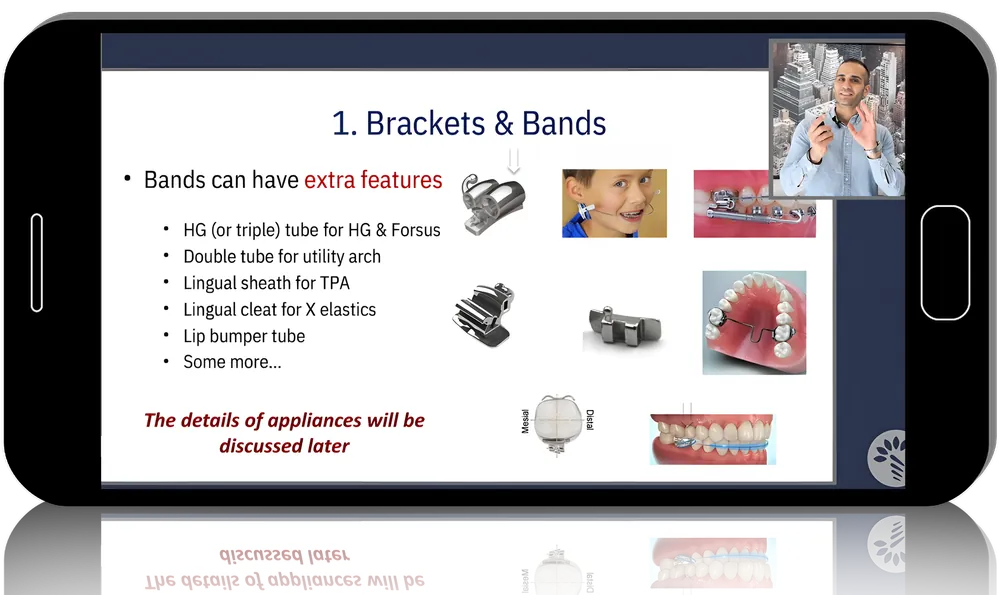
Explore the fundamentals of orthodontic brackets and bands, covering their types, materials, and proper placement techniques. Key concepts such as bracket prescriptions, slot sizes, and the importance of accurate positioning are discussed. The presentation delves into the evolution of orthodontic appliances, from traditional methods to modern prescriptions, and examines how different bracket systems address various clinical challenges.
Lesson explores various orthodontic bracket prescriptions, focusing on their unique features and clinical applications. The MBT prescription is examined in detail, including its torque specifications and versatility in different cases. Other systems like Roncone, Damon, and T-Brace are also discussed, highlighting their design philosophies and intended benefits. The presentation delves into how different prescriptions affect treatment outcomes, emphasizing the importance of clinical judgment over specific bracket systems.
Discover the principles of wire selection and sequencing in orthodontic treatment. Lesson delves into the stages of treatment, wire properties, and arch wire forms, providing insights into the mechanics of different wire types. The discussion covers various materials, including NiTi and stainless steel wires, their characteristics, and appropriate applications. By examining case studies and clinical considerations, it offers practical guidance on choosing and utilizing wires effectively throughout the orthodontic process, from initial alignment to finishing stages.
Delve into the intricacies of orthodontic wire properties and their applications in treatment. It covers the stages of orthodontic treatment, wire characteristics, and various bending techniques used to achieve desired tooth movements. The discussion encompasses friction in orthodontics, different types of wire bends, and the use of loops for space closure. By examining these topics in depth, practitioners can gain a better understanding of how to effectively utilize wires and bends to achieve optimal treatment outcomes.
Understand the biological side of orthodontics. Lesson delves into the physiology and histology of tooth-supporting structures, including gingiva, periodontal ligament, cementum, and alveolar bone. The principles of physiologic tooth migration and orthodontic forces are examined, along with their effects on periodontal tissues, sutures, and the temporomandibular joint. The discussion covers various types of tooth movements, force applications, and theories explaining cellular responses to orthodontic stimuli.
Explore the uses of lingual arches for anchorage, space maintenance, and arch development. Lesson covers the concept of leeway space and its importance in managing crowding during mixed dentition. The presentation examines different types of terminal planes and their implications for future occlusion. Through case studies, it demonstrates how lingual arches can be effectively utilized in both phase one and phase two treatments to create and maintain space, potentially avoiding extractions.
An introduction to banded rapid palatal expansion (RPE). Lesson covers the indications, types, and designs of bonded RP
Es, as well as the biology behind their effectiveness. The mechanics and activation protocols for protraction face masks are discussed, along with their impact on maxillary growth and dental movement. Several case studies are presented to illustrate the application of these techniques in both early phase and adolescent treatments.
Es, as well as activation protocols and potential complications. The presentation delves into the anatomy of the midpalatal suture and how expansion affects it at different ages. Case studies are examined to illustrate various clinical scenarios and treatment approaches.
Lesson explores the use of tongue spurs and trainers in orthodontic treatment, particularly for open bite cases. It covers indications, physiological impacts, and design considerations for these appliances. The discussion includes various habit control methods, interceptive treatments for vertical growth issues, and the debate between tongue thrusting versus resting position. Case studies are presented to illustrate practical applications and outcomes. The material also touches on psychological impacts, patient acceptance, and potential challenges when using tongue spurs in different age groups.
Learn the purpose and use of bite plates in orthodontics. Lesson covers different types of bite plates, their indications in both phase one and phase two treatments, and various design options. The discussion includes case studies demonstrating how bite plates can be effectively used to correct deep bites, open bites, and crowding. Practical tips and considerations for implementing bite plates in daily orthodontic practice are also provided, helping practitioners understand when and how to incorporate this valuable tool for improved treatment outcomes.
This overview explores the use of distalizers in orthodontics, with a particular focus on headgear. The mechanics, advantages, and potential drawbacks of headgear are discussed, including its effectiveness in Class II malocclusion correction and space creation. Various case studies demonstrate the application of headgear in both phase one and phase two treatments, showcasing its ability to achieve significant skeletal and dental changes. The presentation also touches on patient compliance strategies and addresses common concerns about headgear use.
Lesson explores various orthodontic distalizing appliances, including the Frog, Pendulum, and Distal Jet. It delves into the mechanics, advantages, and potential side effects of each device, highlighting their effectiveness in creating space and correcting Class II malocclusions. Real-world case studies demonstrate the practical application of these appliances, showcasing successful treatment outcomes. The discussion also covers TAD-supported distalizers and their benefits in minimizing anchorage loss. By understanding the nuances of these appliances, orthodontists can make informed decisions on which distalizer to use in different clinical scenarios, ultimately leading to improved patient outcomes.
A guide to making extraction decisions in orthodontics. Learn the clinical reasoning behind when extractions are indicated, alternatives to consider, and how to integrate extractions into a treatment plan. The discussion covers different space closure techniques, including closing loops and sliding mechanics, along with their advantages and potential challenges. By examining case examples and key considerations, this material provides insights into making informed decisions about extractions in orthodontic practice and managing associated risks and complications.