Instant Download
Your unique course download link appears right after you complete your purchase, and is also sent instantly to the email address you provided.
Couldn't load pickup availability

Your unique course download link appears right after you complete your purchase, and is also sent instantly to the email address you provided.
9
6 h 10 min
Google Drive Link, Offline
Thanks to this comprehensive, clinically oriented, and evidence-based training program, you will deepen your understanding of maintaining bone volume, correcting complex horizontal and vertical defects, managing peri- implantitis, and achieving predictable aesthetic and functional outcomes.
Through in-depth analysis of clinical indications, biomaterial selection criteria, and surgical timing, Prof. Massimo Simion explores horizontal and vertical regeneration strategies using both resorbable and non-resorbable membranes—including reinforced e-PTFE membranes—and custom-made titanium meshes.
Special focus is given to the integration of digital technologies, from CBCT evaluation to the pre-surgical design of regenerative devices, and to the surgical management of both posterior and anterior sites, including highly esthetic areas.
Topics covered in the course:
At the end of the course, you’ll be able to:
This first lesson explores how to select regenerative techniques and materials based on the morphology of bone defects and the anatomical zone involved, with a focus on cases of partial edentulism.
Prof. Simion explains the clinical indications for using resorbable and non-resorbable membranes, the targeted use of connective tissue grafts, the evolution of vertical augmentation techniques, and the role of CBCT-designed custom titanium meshes.
Participants will gain essential knowledge and skills for managing complex horizontal and vertical bone defects.
In particular, this lecture covers the following topics:
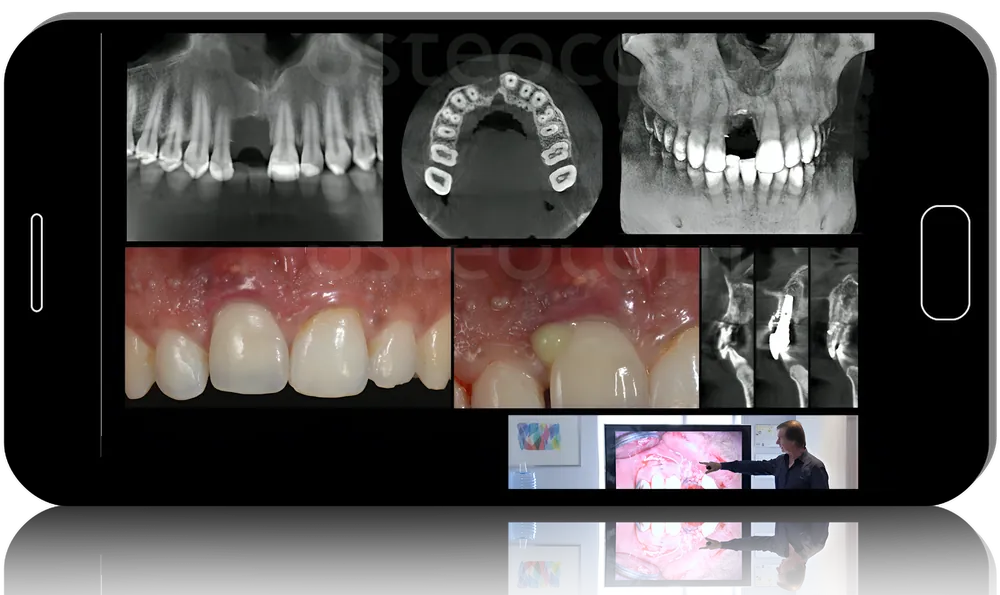
This lesson focuses on the clinical management of a peri-implantitis case affecting a central incisor, complicated by a minimal periodontal attachment loss.
Special emphasis is placed on the correct therapeutic sequence in a highly aesthetic area, where precision in the management of both hard and soft tissues is essential to achieve stable and harmonious results.
Participants will follow the complete surgical protocol—from the extraction of the compromised implant to guided bone regeneration, implant therapy, and the management of peri-implant soft tissues using connective tissue grafts.
In particular, this lecture covers the following topics:
This lesson offers an in-depth exploration of the clinical approach to Guided Bone Regeneration (GBR) in partially edentulous patients, with a specific focus on the treatment of localized defects such as dehiscences and fenestrations.
Prof. Simion presents decision-making criteria for selecting regenerative materials based on the morphology and extent of the defect, supported by practical examples from various regions of the oral cavity.
Complex clinical cases requiring both vertical and horizontal bone augmentation are examined in detail.
In particular, this lecture covers the following topics:
This lesson focuses on the surgical management of anatomically complex cases where the combination of vertical ridge resorption and an enlarged maxillary sinus results in less than 3 mm of residual bone.
In such scenarios, Prof. Simion illustrates a combined approach—vertical ridge augmentation along with sinus lift—as the only viable strategy to achieve sufficient bone height for implant rehabilitation.
The discussion emphasizes cases in partially edentulous patients, particularly in the posterior maxilla, where the defect morphology rules out the use of short implants and requires targeted vertical augmentation using advanced regenerative protocols.
In particular, this lecture covers the following topics:
In this lesson, Prof. Simion explores the clinical indications for Guided Bone Regeneration (GBR) in the anterior mandibular area.
The lesson focuses on effective surgical strategies for treating mixed bone defects, particularly when the vertical component is less than 3 mm. It also examines complex clinical cases involving advanced resorption with vertical bone loss exceeding 3 mm, where the use of reinforced non-resorbable membranes is recommended, along with precise soft tissue management.
In particular, this lecture covers the following topics:
This lesson provides a comprehensive overview of the evolution of regenerative techniques for vertical bone augmentation, with a specific focus on titanium meshes and modern collagen barriers.
Through the analysis of clinical cases in esthetic areas and a detailed explanation of the design process for custom-made meshes, Prof. Simion outlines the criteria for selecting the most appropriate regenerative device based on the defect type and anatomical location.
The lesson also delves into the essential properties a collagen membrane must possess to be truly effective—occlusiveness, rigidity, space maintenance, and tissue integration. A high-value session for professionals seeking to fully understand the clinical and biological rationale behind the use of advanced GBR materials.
In particular, this lecture covers the following topics:
This lesson focuses on the treatment of significant vertical bone defects—greater than 3 mm—in the lower anterior region, a challenging area due to limited bone availability and complex anatomical constraints.
Emphasis is placed on selecting the most appropriate regenerative materials and techniques to achieve stable, predictable vertical augmentation while preserving both aesthetics and function. The use of reinforced non-resorbable membranes and the simultaneous management of soft tissues are presented as essential strategies for the successful resolution of these severe defects.
In particular, this lecture covers the following topics:
This lesson presents a clinical case involving bilateral posterior edentulism in the upper jaw, where a highly pneumatized maxillary sinus requires a careful assessment of the residual bone volume. In selected cases, targeted vertical ridge augmentation can be performed using advanced regenerative devices, enabling implant placement without sinus involvement.
Prof. Simion focuses on surgical indications, material selection, and the clinical rationale for managing these cases effectively and in a minimally invasive way, prioritizing long-term predictability and preservation of sinus anatomy.
In particular, this lecture covers the following topics:
This ReLIVE Surgery showcases an advanced regenerative procedure that combines horizontal and vertical ridge augmentation using a next-generation, custom-designed semi-permeable titanium mesh, tailored from CBCT imaging.
The video provides a comprehensive view of the full surgical protocol—from site preparation to soft tissue management, and the precise placement and stabilization of the custom mesh.
In particular, this lecture covers the following topics: