Skip to product information
1 of 1
🏷️ Save up to 80% on all courses, discount auto applied

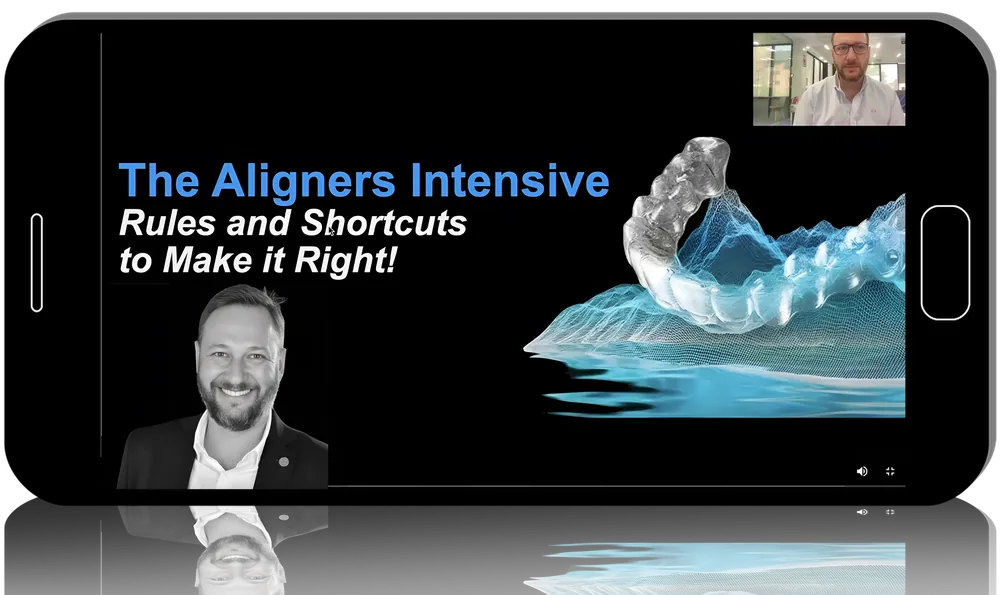
Aligners: From Beginner To Expert

Aligners: From Beginner To Expert

Regular price $57.00 USD
Regular price $421.00 USD Sale price $57.00 USD
Sale Sold out
Shipping calculated at checkout.
Girl in a jacket

Instant Download

Your unique course download link appears right after you complete your purchase, and is also sent instantly to the email address you provided.

Professors

Target audience

General dentists; Orthodontists

Nb of lessons

12

Nb of modules

Course duration

15 h 05 min

Delivery method

Google Drive Link, Offline

Course Overview

A must have training modules on working with aligners: from biomechanics to the treatment protocols of complex clinical cases.

In the first block you will learn the principles of planning the ideal smile and biomechanic basics of working with aligners.

In the second block you will receive step-by-step aligner treatment protocols of:

  • Teeth crowding
  • Class 2
  • Class 3
  • Open bite
  • Deep bite
  • Complex clinical cases.

Full Course Program

Lesson 1. THE DIGITAL ORTHODONTICS DIAGNOSIS ROCKS AND PRINCIPLES FOR IDEAL SMILESINTRO: Why Aligners?

  • Aligners vs. Brackets
  • Understanding the needs of the patient
  • Basics concepts of tooth movement applied to Aligners

The biology of tooth movement:

  • Direct theory,Indirect theory,Biphasic theory
  • Digital Diagnosing guided by the Face, TM
  • Js, Airway, Occlusion and Dental-Skeletal concepts
  • The 5 fundamental principles of biomechanics
  • Live Case Evaluation and Planning.

Duration: 1 h 27 min

Lesson 2. ALIGNERS BIOMECHANICS TIPS: ATTACHMENTS & STAGING

History of modern orthodontics;

The biomechanical tree - Attachments:

  • The concept of attachments,The function of attachments,The 2 types of attachments,The classification of conventional attachments - what is the best type for each situation and when is it mandatory to use,Attachments ideal positioning,Clinical tips on attachment debonding,Attachments Mistakes: prevention and correction

The biomechanical tree - Aligners staging:

  • Concept,Types of Staging,How to plan an ideal staging for each case,When to perfrom sequential movements,Staging Mistakes: prevention and correction.

Duration: 1 h 25 min

Lesson 3. ALIGNERS BIOMECHANICS TIPS: ELASTICS, RAMPS AND ADDITIONAL TOOLS

The biomechanical tree - Auxiliary ressources

Bite ramps:

  • The concept and indications,Types of ramps and their applications,Techniques for when and how to place bite ramps

Elastics:

  • The concept and indications,Buttons: indication, function, and ideal positioning,Hook cuts: indication, function, and ideal positioning,Clinical prescription of elastics for different malocclusions

Additional Tools:

  • Fake Attachments: indication, function, and ideal positioning,Pressure bumps: indication, function, and ideal positioning,Rotation bumps: indication, function, and ideal positioning,Retention bumps: indication, function, and ideal positioning,Torque bumps: indication, function, and ideal positioning,Lingual Spurs: indication, function, and ideal positioning.

Duration: 1 h 27 min

Lesson 4. ALIGNERS BIOMECHANICS TIPS PREDICTABILITY & OVERCORRECTION

Aligners predictability:

The concept and literature review,Tips to improve predictability with aligners,Aligners troubleshooting:

  • Why do we lose tracking of aligners treatment?
  • How to proceed when you lose track of aligners treatment?

Overcorrection:

  • The concept and literature review,What kind of orthodontic movements need overcorrection?
  • How to apply the concept of overcorrection with aligners

Simulating biological response Nonsurgically:

  • Indication for using High Frequency Vibration (HFV),HFV during active treatment,HFV during retention,High Frequency Vibration biological effect

Simulating biological response Surgically:

  • Indications,The goal of bone stimulation,Corticotomy: indications and techniques,Guided corticotomy: indications and techniques,Micro-osteoperforations (MOP): indications and techniques,Enhancing aligners treatment with MOP.

Duration: 1 h 14 min

Lesson 5. CROWDING PROTOCOLS WITH ALIGNERS

Braces vs. Aligners: Can we treat all cases with Aligners?

  • Class 1 malocclusion classification: Diastemas, crowding, and posterior crossbite
  • Diastema treatment protocols: ortho, ortho-restorative, restorative
  • Crowing treatment protocols: simple and severe crowding cases
  • The IPR strategy
  • Posterior crossbite treatment protocols: expansion, root and crown analysis
  • Extraction and aligner therapy: when to extract teeth?
  • Clinical case analysis
  • Analysis of the most common mistakes.

Duration: 1 h 08 min

Lesson 6. CLASS 2 PROTOCOLS WITH ALIGNERS

  • Class 2 concept and diagnose
  • Step by step features of digital diagnosing
  • Class 2 treatment protocols: an overview
  • Aligners Limitations and adjunct therapies to overcome
  • Sequential staging of class 2: ordering sequential distalization
  • Protocols of Class 2 treatment in growing patients
  • Mandibular advancement with aligners
  • Ortho-orthognathic cases
  • Clinical and Biomechanical Tips for Class 2
  • Clinical Cases Brainstorming
  • Most common mistakes.

Duration: 1 h 09 min

Lesson 7. CLASS 3 PROTOCOLS WITH ALIGNERS

  • Class 3 concept and diagnose
  • Class 3 treatment protocols: intermaxillary elastics and sequential distalization
  • Aligners Limitations and adjunct therapies to overcome
  • CBCT evaluation of bone tissue of the lower jaw
  • Decision making process for Class 3 treatment
  • Clinical and Biomechanical Tips for Class 3 cases with aligners
  • Fake attachments. How to place them on posterior teeth?
  • Clinical Cases Brainstorming
  • Orthognathic surgery for class 3
  • Most common mistakes.

Duration: 1 h 16 min

Lesson 8. OPEN BITE PROTOCOLS WITH ALIGNERS

  • Open Bite concept and diagnsis
  • Dental and skeletal open bite characteristics
  • Etiology of open bite: hereditary and non-hereditary factors
  • Ortho treatment planning guided by DSD: DSD tool within Clincheck
  • Pathways to correct and properly stabilize Open Bites with Aligners
  • Clinical and Biomechanical Tips for Open Bites correction
  • Lingual spurs: indications and how to place them?
  • Treatment of skeletal open bite in adults: plan A and plan B
  • Clinical Cases Brainstorming
  • Most common mistakes.

Duration: 1 h 12 min

Lesson 9. DEEP BITE PROTOCOLS WITH ALIGNERS

  • Deep bite concept and diagnosis
  • Deep bite treatment planning guided by DSD
  • Attachment selection and positioning for deep bite treatment
  • Bite ramps: indications and positioning
  • Pathways to correct and properly stabilize Deep Bites with Aligners
  • Clinical and Biomechanical Tips for Deep Bites correction
  • Clinical Cases Brainstorming
  • Most common mistakes.

Duration: 1 h 08 min

Lesson 10. EXTRACTION PROTOCOLS WITH ALIGNERS

  • When is treatment with extraction a good strategy?
  • Indication for extracting premolars, 3rd molars, lower incisors
  • Complex crowding cases: expansion, IP
  • Rs, extraction of 4 premolars
  • Class 2 and class 3 treatment with extraction protocols
  • The roller coaster bowing effect
  • Extraction cases tips: extraction time, overcorrection, anchorage loss, and space closure
  • Extraction staging protocols
  • Aligners Limitations in Extractions cases and adjunct therapies to overcome
  • Clinical and Biomechanical Tips for Extraction cases with Aligners
  • Clinical Cases Brainstorming
  • Most common mistakes.

Duration: 1 h 06 min

Lesson 11. TREATING GROWING PATIENTS WITH ALIGNERS

  • Variables that interfere in the predictability with aligners
  • Advantages and Disadvantages of using clear aligners in young patients
  • Diagnosing and Planning for Growth Patients with Aligners
  • The ideal indications and limitations

Clinical and Biomechanical Tips for Growth Patient cases with Aligners:

  • Open bite
  • Anterior and posterior cross bite
  • Class 2: mandibular advancement
  • Space management
  • Controlling growth discrepancies
  • Midline deviation
  • Correcting parafunctional habits
  • Clinical Cases Brainstorming
  • Most common mistakes.

Duration: 1 h 17 min

Lesson 12. ADJUNCT THERAPIES FOR COMPLEX CASES WITH ALIGNERS

  • The limitations of aligners therapy and how to overcome them
  • Skeletal anchorage with aligners
  • How to improve the success rate of TAD’s and what are the risk factors?
  • DSD and TAD’s: analysis and planning
  • TAD guide design
  • DSD Live Treatment Planning (LTP)
  • DSD and Clincheck Treatment Planning Session (TPS)

Surgical and non-surgical methods to stimulate the biological response to orthodontic forces:
  • High Frequency Vibration (HFV)
  • SFOT (Surgical Facilitaed Orthodontic Therapy): corticotomy and bone graft
  • MOP’s (Micro-osteo Perforations)
  • DSD for SFOT guide design
  • Clinical cases.

Duration: 1 h 16 min

View full details