Instant Download
Your unique course download link appears right after you complete your purchase, and is also sent instantly to the email address you provided.
Couldn't load pickup availability

Your unique course download link appears right after you complete your purchase, and is also sent instantly to the email address you provided.
14
13 h
Google Drive Link, Offline
Advanced lateral window sinus surgery and its alternatives, from clinical decision-making to refined surgical execution. This Masterclass is designed for ambitious early-career clinicians wishing to master maxillary sinus procedures, as well as seasoned periodontologists and implantologists who want to align their daily practice with the most current, research-backed protocols.
The course follows a hands-on, “from the operatory” perspective, guiding you through every phase of sinus lift surgery. You will be led stepwise from initial diagnosis and case indication to the practical management of intraoperative challenges and postoperative issues.
Throughout this structured, evidence-based program, you will explore how sinus lift concepts and techniques have evolved over recent decades and understand why sinus grafting remains pivotal for long-term implant survival. A focus will be placed on how an updated flap design and a refined antrostomy approach can make the lateral window procedure more conservative while lowering the incidence of complications after surgery. Join Prof. Testori and immerse yourself in a comprehensive, clinically grounded experience in maxillary sinus surgery.
Course content includes:
By the conclusion of the Masterclass, you will be able to:
In the opening session of this Masterclass, Prof. Testori introduces the full spectrum of therapeutic approaches for maxillary sinus elevation and explains how to select the most appropriate strategy for each case. He examines the key elements that guide this decision-making process, including the patient’s main concern, economic considerations, the clinician’s level of experience, and several additional clinical variables.
He emphasizes that treatment planning should aim to maximize predictability and workflow efficiency by integrating digital technologies and rigorously validated, evidence-based protocols. As the lesson progresses, the focus shifts to more advanced clinical aspects: when it is advisable to involve an ENT specialist, strategies to reduce the risk of problems during and after surgery, the anatomical and biological characteristics of the maxillary membrane, and how to recognize an unhealthy sinus through its clinical manifestations.
More specifically, this lecture explores:
This session is dedicated to understanding what makes a maxillary sinus elevation simple, moderate, or highly demanding. Professor Testori presents his Sinus Elevation Difficulty Score, showing how this practical grading system allows clinicians to immediately grasp how challenging a specific sinus lift procedure will be. Since choosing the right patient and case is crucial when approaching maxillary sinus augmentation, special emphasis is placed on decision-making for case selection, with clear guidance on which situations are most suitable for younger or less experienced practitioners.
More specifically, the lesson explores:
In this session, Prof. Testori explores the clinical strategy behind managing maxillary sinus elevation. He explains how to clinically recognize warning signs of sinus infection, including the presence of graft material in the ostium and the onset of sinusitis.
The lesson emphasizes the importance of close collaboration with ENT specialists at the diagnostic stage, so implantologists can more accurately identify thickened or diseased sinus membranes caused by subclinical sinusitis.
Key points addressed in this lesson include:
In this recorded lesson, Prof. Testori walks through multiple real clinical cases to illustrate how to work with various biomaterials, including Novomatrix, used together with fibrin sealant and Baxter Deerfield. He then dedicates a section of the session to exploring in detail how collagenated porcine dermal matrices function and what specific benefits they offer in clinical practice.
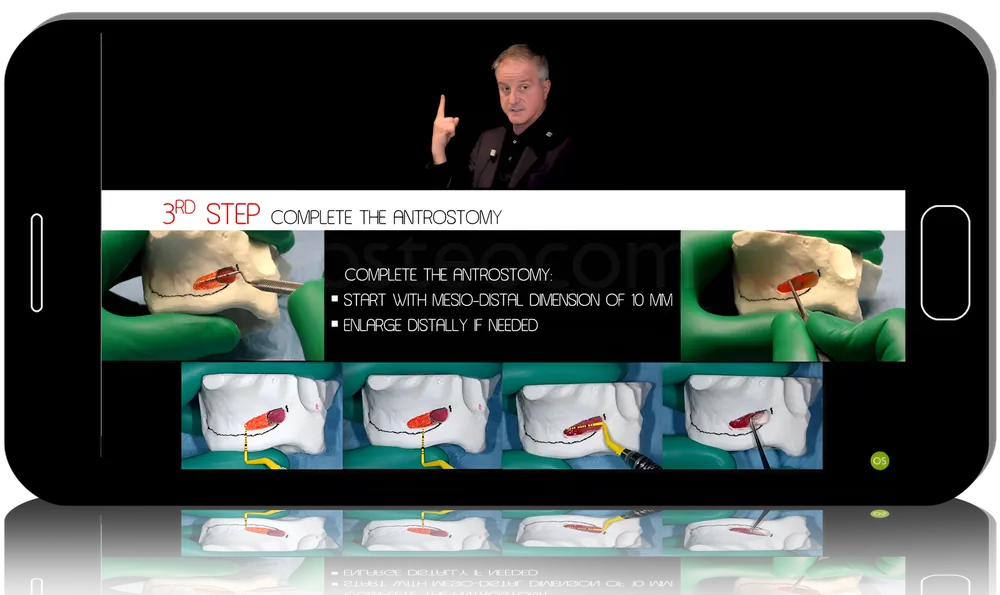
Following an overview of the scientific rationale for clinical protocols and the essential diagnostic steps, Prof. Testori moves from theory to live surgery, narrating each phase in detail as he works. He begins by demonstrating his complete anesthetic sequence, then focuses on an advanced flap approach that he regards as the decisive element in every sinus lift. To conclude, he compares techniques for creating the antrostomy window, examining how to optimize the procedure with both piezoelectric technology and conventional rotary tools.
This session specifically explores:
Following an overview of antrostomy, Prof. Testori shifts the focus to osteotomy, management of the bony window, and the practical use of the DASK technique. He then demonstrates how to make full use of DASK as a comprehensive kit that supports multiple sinus lift approaches.
This session specifically walks through:
Prof. Testori presents an innovative configuration for creating the antrostomy, making it easier to separate and elevate the sinus membrane during sinus floor augmentation procedures.
In this session, you’ll explore the recently introduced Low Window Technique and how it reshapes surgical planning. Professor Testori demonstrates how this approach streamlines the incision strategy, relying on a single linear cut without releasing incisions. By simplifying the flap design, the technique helps reduce postoperative discomfort, minimizing pain, bruising, and swelling for the patient.
In this session, Prof. Testori uses a series of surgical video clips to walk you through the typical complications that may arise during a sinus lift. He demonstrates how to recognize these issues as they happen and illustrates practical strategies for handling them both during the operation and in the healing period that follows.
Professor Testori emphasizes that the way the flap is planned and executed largely dictates whether a sinus lift will be predictable or problematic, and this session focuses entirely on that stage of the surgery. During the lesson, he also explains in which clinical situations implant site preparation is required, how it should be performed, and which suturing sequence is most appropriate to finalize the procedure.
The crestal technique has long carried a reputation for being unreliable and overly hazardous. Prof. Testori, however, regards it as a reliable option when used in carefully selected situations—specifically, in patients without vertical defects, with only minor horizontal deficiencies, and in the presence of a spacious sinus cavity.
In the final theory-focused session of the Masterclass, Prof. Testori explores treatment options that can replace a traditional sinus lift. He discusses when and how to use All-on-4, transinusal implants, zygomatic implants, and the M.I.F.A (Minimally Invasive Full Arch) protocol as alternative solutions.
In this opening ReLIVE Surgery session, Prof. Testori will perform a bilateral sinus augmentation and walk you through each phase of the operation in a clear, sequential manner. The patient currently wears a complete maxillary denture that lacks stability and comfort. Because the patient declined the option of zygomatic implant placement, the agreed-upon treatment approach is an overdenture anchored on six conventional implants.
In the final ReLIVE Surgery of the course, you’ll see one comprehensive clinical case that brings everything together—putting into practice, in a single procedure, all the concepts, techniques, and protocols previously presented and discussed throughout the program.